
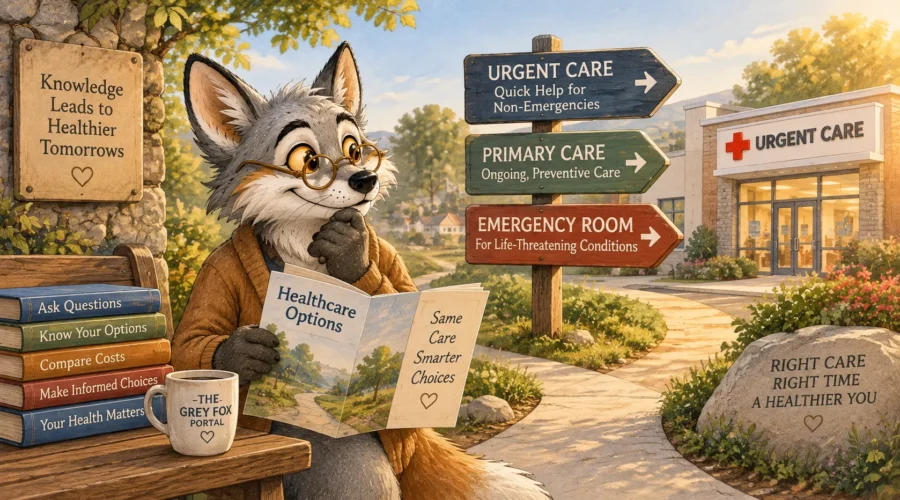
A Grey Fox newsletter article on when urgent care helps, when it may be overused, and how smart patients can make better healthcare decisions.
For The Grey Fox Newsletter
Drive through almost any American town today and you will see the signs: walk-in care, short wait times, evening hours, weekend availability, and no appointment needed. Urgent care centers have become as familiar as pharmacies, grocery stores, and coffee shops. For many families, and especially for older adults, they serve as a practical middle ground between waiting days for a primary care appointment and spending hours in a hospital emergency room. Their rise reveals both the strengths and weaknesses of modern American medicine.
Need stitches after a fall? Have a possible urinary tract infection on a Saturday? Dealing with a persistent cough when your doctor’s office is closed? Urgent care can be a welcome solution. But the rise of urgent care is about more than convenience. It is also a story about insurance, patient expectations, physician burnout, business incentives, and the growing tension between healthcare as a profession and healthcare as an industry.
Understanding that tension can help patients use urgent care wisely: taking advantage of its accessibility when it truly helps, while avoiding the costly trap of seeking medical intervention for every ordinary discomfort.
How Urgent Care Was Born
Urgent care developed to fill a gap in American healthcare. Many patients had medical problems that needed prompt attention but were not true emergencies. At the same time, same-day appointments with family doctors were often difficult to obtain, particularly after hours or on weekends.
- Emergency rooms were becoming crowded with non-emergency problems.
- Primary care offices often had limited same-day, evening, and weekend access.
Instead of waiting several days for an office visit or spending hours in an emergency department, patients could walk into a clinic and usually receive treatment the same day. Early urgent care clinics were often physician-owned, retail-style practices designed for acute but non-life-threatening illnesses and injuries.
Over time, the model became more formal and more attractive. Patients liked the convenience. Insurers liked the lower cost compared with emergency-room care. Health systems and investors saw a scalable business opportunity.
Today, urgent care is a major part of the healthcare landscape. Industry summaries estimate more than 15,000 urgent care centers nationwide and more than 200 million patient visits annually, with growth driven by consumer demand, insurance design, and investor interest.
The Benefits of Urgent Care
Urgent care centers offer real advantages when used for the right reasons.
Convenience
Many clinics offer features that fit modern life:
- Evening hours
- Weekend availability
- Walk-in appointments
- Online scheduling
- On-site X-rays or basic lab testing at some locations
For working adults, families, and retirees alike, that convenience can be a significant advantage.
Lower Costs Than Emergency Rooms
A minor illness or injury treated in an urgent care center usually costs far less than treatment in a hospital emergency department. A 2025 systematic review found that urgent care clinics can reduce emergency department use for non-urgent conditions, improve resource allocation, and lower overall costs when integrated well into the healthcare system.
For patients, the advantage is not only speed, but also the possibility of avoiding the much higher out-of-pocket expense that often comes with emergency-room care.
Faster Access for the Right Problems
Most urgent care visits involve conditions that need prompt attention but are not immediately life-threatening. Examples include:
- Ear infections
- Minor fractures or sprains
- Cuts that may need stitches
- Urinary tract infections
- Flu-like symptoms or respiratory illnesses
- Minor burns, rashes, or allergic reactions
For these conditions, urgent care can provide timely evaluation while helping preserve emergency rooms for chest pain, stroke symptoms, major trauma, severe shortness of breath, signs of sepsis, and other true emergencies.
Local Snapshot: How Atlanta Urgent Care Centers Compare
Because The Grey Fox Newsletter serves a national audience, the table below should be read as a local example rather than a national ranking. We use Atlanta as a sample market to show how readers in any city can compare urgent care options by rating trends, recent reviews, insurance participation, hours, and available services.
| ATLANTA-AREA URGENT CARE RATING SNAPSHOT Highest- and lowest-rated centers from available public listing data | |||
| Top-Rated Centers | |||
| Rank | Center | Area | Rating |
| 1 | AFC Urgent Care, East Cobb | Marietta | 4.91 |
| 2 | Piedmont Urgent Care Brookhaven | Brookhaven | 4.88 |
| 3 | Atlanta Urgent Care, Druid Hills | Atlanta | 4.73 |
| Lower-Rated Centers in the Available Snapshot | |||
| Rank | Center | Area | Rating |
| 1 | Comprehensive Primary & Urgent Care, CPAUC of Atlanta | Norcross | 3.50 |
| 2 | Piedmont Urgent Care Buckhead North | Atlanta | 3.91 |
| 3 | Wellstar Urgent Care – Vinings | Smyrna | 4.06 |
| Newsletter note: Ratings can change quickly and may reflect customer service, billing, wait times, cleanliness, and convenience as much as clinical quality. Atlanta is used here as a sample comparison for a national audience; readers should repeat the same check in their own community before choosing care. | |||
The Business Model Behind Urgent Care
Urgent care is healthcare, but it is also a business. Unlike hospitals, urgent care centers typically avoid the enormous fixed costs of operating trauma units, intensive care units, operating rooms, and around-the-clock specialty services.
Most clinics operate in commercial retail spaces, with relatively predictable staffing, equipment, and overhead costs. That makes the model easier to replicate, but it also means the economics depend heavily on steady patient volume.
Like any retail service, more visits generally mean more revenue. This does not mean urgent care providers are unethical. Most are dedicated professionals trying to help patients. But the system’s financial incentives reward activity: more visits, more tests, more procedures, and more prescriptions.
Insurance: The Hidden Driver
The growth of urgent care would not have happened on this scale without health insurance. Most patients do not experience the full cost of care at the point of service. Instead, they experience healthcare through:
- Copays
- Deductibles
- Coinsurance
- In-network and out-of-network rules
A patient may pay a relatively small copay while the insurer pays the rest. That makes the visit feel inexpensive, even when the total bill is much higher. Insurers often encourage urgent care because it can be less expensive than emergency-room care for non-emergency conditions.
Understanding Moral Hazard
Economists use the term moral hazard to describe what happens when people use more of a service because they are shielded from much of its cost. The phrase sounds judgmental, but it is not about morality. It is about incentives.
Healthcare is a classic example. If a visit costs $250 and you pay the entire amount yourself, you may pause and ask whether the visit is truly necessary. If your share is only a $25 copay, the decision becomes much easier.
Insurance lowers the financial barrier to care, and that is often a good thing. People should not avoid necessary medical treatment because they are afraid of the bill. But lower barriers can also encourage visits that are not medically necessary, especially when convenience is high and patience is low.
When Convenience Creates Demand
Thirty years ago, many common illnesses were first managed at home: a mild cold, a routine cough, a minor stomach bug, or a sore throat without alarming symptoms. Rest, fluids, observation, and time were often the first line of response.
Today, the situation is different. Urgent care centers are nearby, insurance covers much of the cost, and patients have become accustomed to immediate access. As a result, many people seek medical evaluation for conditions that previous generations often managed themselves.
This is sometimes called induced demand: when a service becomes easier to access, people tend to use it more often. In healthcare, that can be helpful when it replaces unnecessary emergency-room visits. It can be wasteful when it turns ordinary, self-limited discomfort into a billable medical encounter.
The Cost of Unnecessary Care
Not every urgent care visit leads to unnecessary treatment, but convenience can create expectations. Patients often feel that a visit should produce something tangible:
- A prescription
- An antibiotic
- A lab test
- An X-ray or scan
- A definite diagnosis
- Immediate reassurance
Yet many common conditions improve without medical intervention. A viral cold does not improve because of antibiotics. A minor strain often heals with time. Many common illnesses simply need patience, careful observation, and clear instructions about when to seek more help.
Antibiotics are an important example. The CDC emphasizes outpatient antibiotic stewardship because unnecessary antibiotics can expose patients to side effects and contribute to antimicrobial resistance. Research in a large urgent care network found that antibiotics were prescribed in 34% of urgent care encounters, with respiratory conditions accounting for most antibiotic prescribing.
The concern is not just the cost of the visit itself. One unnecessary visit can lead to a chain of additional testing, prescriptions, specialist referrals, and follow-up appointments. Sometimes more medicine produces better care. Sometimes it simply produces more medicine.
The Doctor’s Dilemma
Doctors are often expected to prevent overuse, and good physicians do exactly that by knowing when treatment is necessary and when observation is appropriate. But clinicians also work under real pressure: legal risk, patient expectations, short appointment times, and productivity targets.
Defensive Medicine
Missing a serious diagnosis can have devastating consequences. For that reason, some providers order additional tests not because disease is likely, but because disease is possible. The motivation is understandable: no one wants to miss the rare but dangerous condition hiding among routine complaints.
A Present-Day Legal Scenario
Consider a common modern scenario: a patient arrives at an urgent care center with chest tightness, fatigue, and mild shortness of breath. The symptoms may turn out to be anxiety, indigestion, or a respiratory infection. But they could also signal a heart problem, a blood clot, or another serious condition. If the clinician sends the patient home and something goes wrong, the legal risk can be significant. If the clinician orders additional tests or refers the patient to the emergency room, the visit may become more expensive and frustrating for the patient.
That is the legal squeeze facing many clinicians today. Malpractice concerns can encourage defensive medicine, while federal surprise-billing rules and payment-dispute processes have increased scrutiny around what patients are charged and how providers are reimbursed. At the same time, some states are paying closer attention to private equity, corporate ownership, and management-service arrangements in healthcare because lawmakers worry that business control could influence clinical judgment.
For patients, the takeaway is practical: legal and regulatory challenges are not abstract issues. They can shape wait times, referral decisions, billing experiences, and the amount of testing recommended during a visit. The best urgent care centers balance caution with judgment, transparency with efficiency, and access with restraint.
Patient Satisfaction
Patients frequently leave more satisfied when a visit produces something tangible: a prescription, a test, a diagnosis, or a treatment plan. Telling someone they need rest and time may be medically correct, but it can feel emotionally unsatisfying. That pressure can encourage additional interventions even when watchful waiting would be reasonable.
The Productivity Problem
Modern medicine also runs on tight schedules. Many clinicians are expected to see large numbers of patients each day, often with only minutes for listening, examining, educating, and reassuring. Yet reassurance is often exactly what patients need.
Explaining why an antibiotic is unnecessary may take longer than prescribing one. Discussing why a scan may not help can take longer than ordering it. In that environment, time itself becomes one of the scarcest resources in healthcare.
The Equipment Problem
Modern medical practices face substantial financial pressures. Office rents have increased, staff wages continue to rise, technology systems are expensive, and insurance reimbursement remains complex and often frustrating.
In response, many practices invest in revenue-generating equipment such as X-ray machines, ultrasound systems, diagnostic-testing platforms, and laboratory equipment.
These technologies can improve patient care and convenience, but they also create a difficult business reality: equipment is expensive, and expensive equipment must generate revenue. A machine that sits unused does not pay for itself.
No one needs to act unethically for incentives to influence behavior. The simple fact that a practice has invested hundreds of thousands of dollars in technology can subtly encourage greater utilization.
This is not unique to healthcare; it exists in every industry. The challenge is ensuring that medical judgment remains the primary driver of decisions.
The Healthcare Paradox
America has developed a healthcare system with remarkable strengths: advanced technology, rapid access to diagnostics, extensive medical expertise, and growing convenience.
Yet we also face rising costs, physician burnout, and increasing concern about overtreatment.
Urgent care centers sit squarely in the middle of that contradiction. They provide valuable access, reduce emergency-room congestion, and save money in many situations. Yet they also contribute to a culture where every symptom demands attention and every discomfort seeks a medical response.
The Grey Fox Perspective
One advantage of aging is perspective. Many older adults remember a time when medical care was less convenient but often more deliberate. Not every cough required a visit, not every ache required an MRI, and not every illness required medication. That is not nostalgia; it is a reminder that medicine has limits.
Urgent care centers are neither heroes nor villains. They are useful tools in a healthcare system struggling to balance access, affordability, efficiency, and quality.
The wisdom lies in knowing when to use them—and when not to.
Seek care for genuine concerns, and do not ignore serious symptoms. But remember that some of life’s most common ailments still respond best to the oldest treatment known to medicine: rest, patience, time, and perhaps a little of the common sense that comes with growing older.

Final Word: Use Urgent Care Wisely
Urgent care is one of the clearest examples of the promise and pressure of modern healthcare. At its best, it gives patients timely access, reduces unnecessary emergency-room visits, and helps families handle real medical concerns without waiting days for help. At its worst, it can turn convenience into overuse, anxiety into testing, and ordinary discomfort into another bill.
For readers everywhere, Atlanta’s urgent care market is not the exception; it is an example. Every community now faces the same basic question: how do we make healthcare easier to reach without making it easier to overuse?
The answer begins with informed patients. Check ratings, but read recent reviews. Confirm insurance, but ask what services are available. Use urgent care when symptoms are concerning, time-sensitive, or difficult to evaluate at home. But when a mild illness simply needs rest, hydration, observation, and patience, remember that good healthcare is not always more healthcare.
The Grey Fox takeaway: urgent care is a valuable tool, not a first reflex. The wisest patients are not the ones who avoid care, nor the ones who seek it for every symptom. They are the ones who know the difference.