
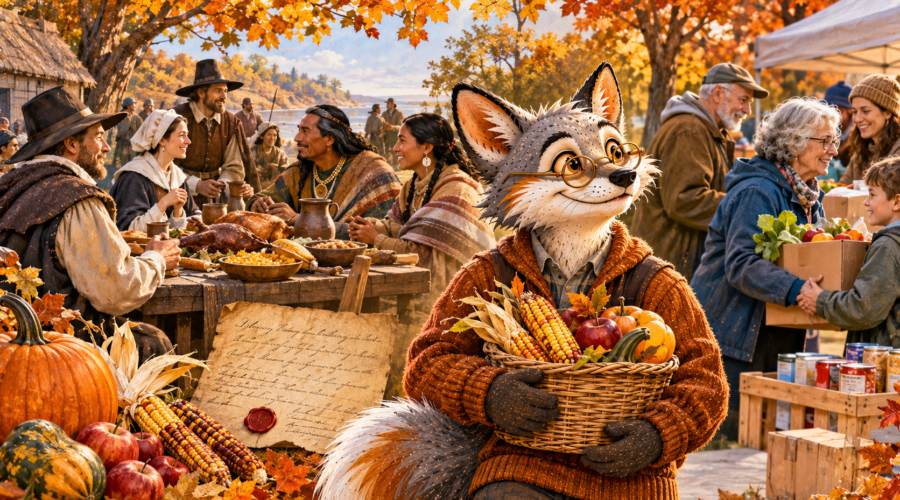
| thegreyfoxportal A feast, a footnote, and a holiday worth sharing |
Pass the potatoes—and a little perspective. Thanksgiving’s story is richer than a single harvest feast: it includes ancient traditions of gratitude, a few precious lines in a letter, a determined magazine editor, and a presidential calendar change that left Americans wondering when to serve dinner. Pull up a chair: there’s more to this holiday than the turkey.
A harvest gathering, not a holiday launch
In autumn 1621, English colonists at Plymouth and at least 90 Wampanoag people gathered to mark a successful harvest. We remember it as the “First Thanksgiving,” but nobody there used that name. The label—and much of the familiar story—came later. Indigenous harvest traditions and other colonial days of thanksgiving also predated the Plymouth gathering. (National Archives: Thanksgiving—Historical Perspectives) (Smithsonian: Thanksgiving History)
Gratitude was here before the Mayflower. Long before English colonists arrived, Native peoples marked seasonal occasions with thanksgiving traditions, including Strawberry Thanksgiving and Green Corn Thanksgiving. English communities also had traditions of giving thanks, often through specially declared days of prayer. The Plymouth gathering brought together people with their own ways of honoring a harvest; it did not invent gratitude in North America. (Plimoth Patuxet Museums: Thanksgiving)
The Wampanoag were not supporting characters who appeared just in time for dinner. The colonists had settled on Wampanoag land, and Wampanoag knowledge of planting and hunting helped make their survival and the harvest possible. Their alliance was a strategic relationship between distinct peoples, not simply a feel-good holiday scene. (National Archives: Thanksgiving—Historical Perspectives)
A gathering with diplomatic stakes. Ousamequin, often called Massasoit in English accounts, attended with about 90 Pokanoket men. Edward Winslow’s account also mentions other Indigenous people, without identifying everyone present. Historians therefore cannot reconstruct a complete guest list or confidently explain every participant’s motive. Plimoth Patuxet Museums discusses the gathering in the context of treaty-making and diplomacy—a useful reminder that a shared meal can carry political meaning as well as hospitality. (Plimoth Patuxet Museums: Eye-Witness Account of the 1621 Harvest Celebration)
Our window into the feast is a letter, not a menu. Winslow described the celebration in a letter written in December 1621, published the next year in Mourt’s Relation, a promotional pamphlet for the colony. It is the only surviving eyewitness account of the gathering. That makes its few lines invaluable—but also limited: the story reaches us through an English colonist’s perspective, not a complete record of what all the participants thought or experienced. (Plimoth Patuxet Museums: Eye-Witness Account of the 1621 Harvest Celebration)
Was turkey the star? The menu is a mystery
The celebration lasted three days—quite a commitment to the dinner party. But the surviving eyewitness account names only venison and wildfowl. Wampanoag men brought five deer; the English had gone hunting for birds. Turkey may have been served, but historians cannot hand us a complete, confirmed menu. Fish, shellfish, and corn dishes are plausible additions, not a surviving shopping list. (Plimoth Patuxet Museums: 1621 Harvest Menu)
That distinction is part of the fun: history sometimes answers “What’s for dinner?” with “Here’s what we know, and here’s our best guess.” Your family’s favorite spread need not duplicate 1621 to be meaningful. Think of today’s table as a tradition with room for new recipes, rather than a museum display.
Bring that curiosity to your own table. For example, turn dinner into a friendly “history or guess?” game: ask whether turkey is a confirmed item on the 1621 menu, then reveal that the eyewitness account specifically names venison and wildfowl. No prizes required—although first choice of dessert might inspire some spirited participation. (Plimoth Patuxet Museums: 1621 Harvest Menu)
The famous name arrived much later. In 1841, minister and antiquarian Alexander Young republished Winslow’s account and identified the feast as the “first Thanksgiving” in a footnote. Nineteenth-century readers recognized echoes of their own harvest holiday in the older description, helping the Plymouth story become an American origin story. Sometimes a footnote turns out to have a very long afterlife. (Plimoth Patuxet Museums: Memories of Thanksgiving Across the Centuries)
Before the annual holiday: rain and revolution
In 1623, Plymouth experienced a drought that threatened its crops. The governor called for a day of prayer; after rain ended the drought, the colonists set aside a day of thanksgiving. This was different from the harvest celebration of 1621. Such observances responded to particular events rather than a fixed annual date, and could emphasize worship and reflection instead of a feast. (Plimoth Patuxet Museums: A Day of Thanksgiving, Summer 1623)
The story also has a Revolutionary chapter. In 1777, the Continental Congress proclaimed a national thanksgiving during the War for Independence, before Washington’s 1789 observance under the new Constitution. Its tone was solemn, discouraging ordinary recreation for the occasion. The lesson? “Thanksgiving” has described several kinds of observance; the modern holiday emerged from a longer, changing tradition, not one uninterrupted dinner party. (Plimoth Patuxet Museums: Memories of Thanksgiving Across the Centuries)
The editor who wouldn’t give up
Thanksgiving did not become an annual national observance immediately after Plymouth. George Washington proclaimed a day of thanksgiving in 1789, but later presidential observances varied. Enter Sarah Josepha Hale, a magazine editor who spent decades advocating a shared national Thanksgiving through essays and letters. A newsletter-minded champion of a national dinner? We approve of the editorial ambition. (National Archives: Congress Establishes Thanksgiving) (National Park Service: Lincoln and Thanksgiving)
In October 1863, during the Civil War, Abraham Lincoln called for Thanksgiving on the last Thursday of November. His proclamation urged care for widows, orphans, and those suffering from the conflict, and called for healing the nation. The holiday’s national story was about gratitude amid hardship—not a claim that everything was going wonderfully. (National Park Service: Lincoln and Thanksgiving)
When Thanksgiving needed a calendar referee
In 1939, Franklin D. Roosevelt moved Thanksgiving one week earlier to lengthen the Christmas shopping season. Some states followed him; others kept the traditional date. The result was a country observing Thanksgiving on different Thursdays—an impressive way to complicate “What time should we arrive?” (National Archives: Congress Establishes Thanksgiving)
Congress settled the question, and Roosevelt signed the resolution in December 1941: the federal holiday would fall on the fourth Thursday of November. That is why “fourth Thursday” is the rule, rather than “last Thursday.” (National Archives: Congress Establishes Thanksgiving)
Making room for the whole story
A thoughtful Thanksgiving history also leaves room for grief. The early alliance did not secure lasting peace: war and colonization cost the Wampanoag political independence and much of their territory. For some Native Americans, Thanksgiving is a painful reminder of those losses. Since 1970, the National Day of Mourning in Plymouth has challenged the familiar holiday myth and the stereotypes it carries. (National Archives: Thanksgiving—Historical Perspectives)
We can enjoy a gathering without reducing its history to a cheerful postcard. For example, invite each guest to name someone whose help they appreciate, or read about Wampanoag perspectives together before dinner. Gratitude and curiosity make good dinner companions—and generosity gives them somewhere to go after the dishes are done.
Save a place for generosity
A full table is a wonderful thing. Helping someone else have one is even better. This Thanksgiving, we invite thegreyfoxportal readers to support a nonprofit whose mission matters to them. Give an amount that fits your budget, consider an ongoing gift if you can, or offer your time. Kindness does not require a grand gesture—or a place on the seating chart.
Try one of these ideas: These are illustrative ways to take part, not activities organized by thegreyfoxportal.
- Turn dessert into a giving moment. Invite willing guests to make a donation of their choice instead of bringing another pie. Keep participation optional and amounts private.
- Make generosity a family tradition. Let each household suggest a cause, talk about why it matters, and choose an organization to support together.
- Give time as well as money. Contact a local food bank or Meals on Wheels provider about volunteer opportunities. Ask what help is needed and arrange participation before arriving. (Feeding America) (Meals on Wheels America)
Take one step today: Choose a cause, visit an official giving page below, and make a donation you can comfortably afford. Prefer to give locally? Ask a nearby nonprofit what it needs most before collecting food or other items. The national organizations below are starting points, not thegreyfoxportal partners or endorsements.
Where to give and whom to contact
| Help address hunger Feeding America Supports a network of food banks helping neighbors facing hunger. (Feeding America) Donate by phone: 800-910-5524. (Feeding America) https://www.feedingamerica.org/ways-to-give/give-offline https://www.feedingamerica.org/contact Mail donations: Feeding America, P.O. Box 96749, Washington, DC 20090-6749. (Feeding America) | Support older adults Meals on Wheels America Supports a network providing older adults with nutritious meals, connection, and care. (Meals on Wheels America) Donate by phone: 703-548-5558 (Development team). (Meals on Wheels America) https://www.mealsonwheelsamerica.org/donate/ https://www.mealsonwheelsamerica.org/about/contact/ Mail donations: Meals on Wheels America, P.O. Box 791568, Baltimore, MD 21279-1568. (Meals on Wheels America) |
This Thanksgiving, let’s make gratitude more than something we say before dinner. Let’s make it something we do. May your conversation be warm, your curiosity well fed, and your generosity reach beyond your own table.