
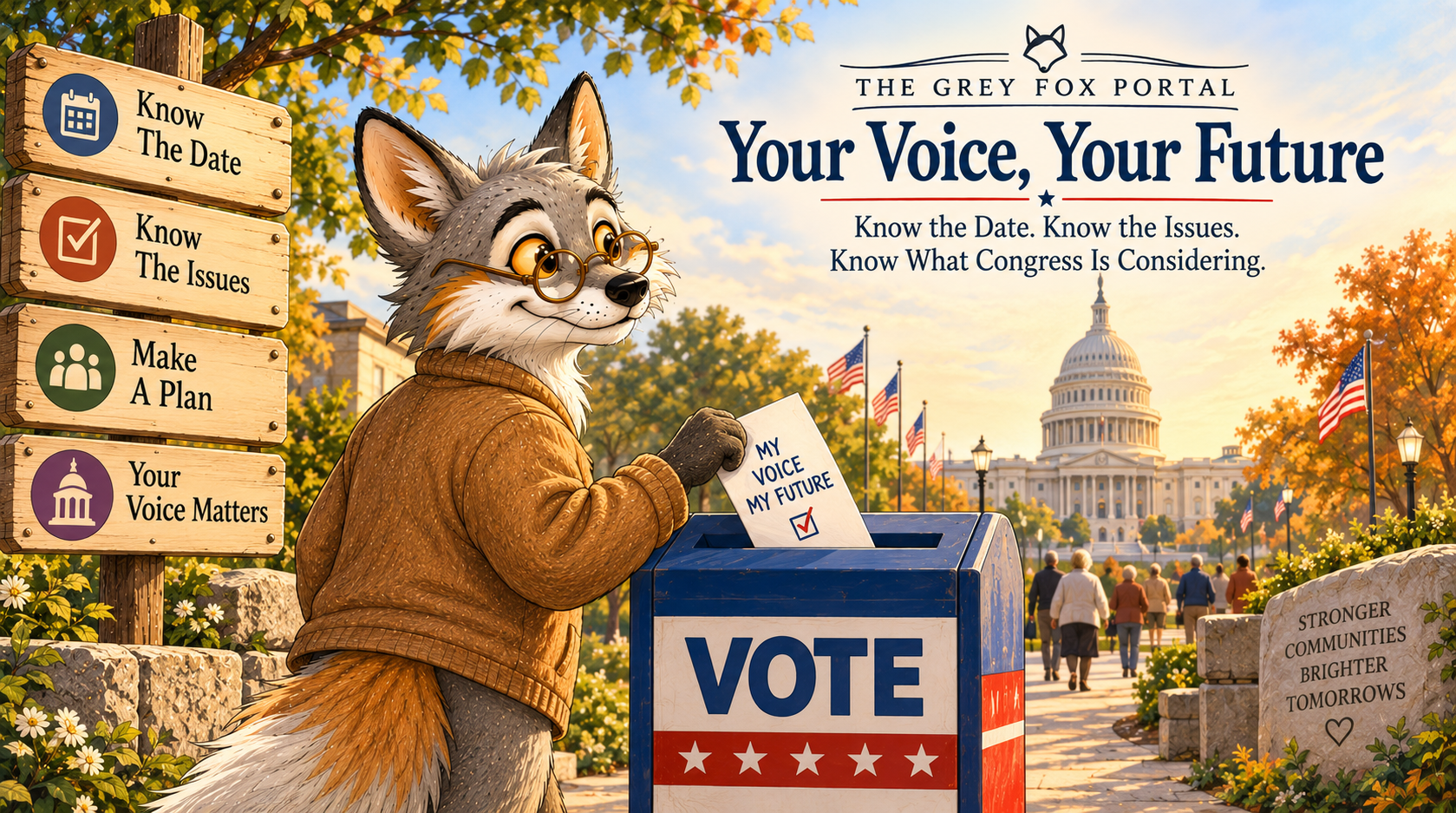
THE GREY FOX PORTAL
Your Voice, Your Future
Know the Date. Know the Issues. Know What Congress Is Considering.
Voting matters—but getting ready does not have to feel complicated. This easy-to-scan newsletter brings the essentials together: how to prepare, where to confirm registration rules, how voting rights expanded, what the two major parties say they want to accomplish, and which related bills are moving through Congress. Take it one section at a time, follow the official links, and share useful information with family, friends, and neighbors. The Grey Fox Portal provides this guide for nonpartisan voter education and does not endorse a party or candidate.
Why This Election May Matter to You
- Your pocketbook: Taxes, prices, wages, retirement income, and household costs.
- Your health: Medicare, Medicaid, prescription costs, insurance, and access to care.
- Your community: Education, public safety, infrastructure, energy, and local services.
- Your voice: Voting rules, election administration, and representation in Congress.
Take the one-minute challenge: Can you name your registration deadline, your voting method, and the two issues you most want to research? If not, use the checklist below to fill in the gaps.
Your Four-Step Voter Checklist
- Check your registration. Confirm your name, address, and status before your state deadline. Start at Vote.gov.
- Choose how you will vote. Review the early, mail, absentee, and Election Day options available in your state. Use the Vote.gov voting guide.
- Verify state rules. Confirm identification, ballot-return, polling-place, and deadline details through the U.S. Election Assistance Commission.
- Follow legislation. Read bill text and check whether a measure is introduced, passed, or enacted at Congress.gov.
Election 2026: Mark the Date and Make a Plan
Circle the date: Tuesday, November 3, 2026. That is the next U.S. midterm general election. Primary dates, registration deadlines, and early-voting periods vary by state, so confirm the rules where you live before making your plan. Source: USAFacts.
Find your registration deadline now. Go to Vote.gov or the U.S. Election Assistance Commission, select your state, and confirm your registration status, identification requirements, and deadlines for mail or in-person registration. Save the information with your election plan so you do not have to search for it later.
How the Right to Vote Expanded
The right to vote did not arrive for everyone at once. The Constitution initially left most voter qualifications to the states, and access expanded through amendments, federal laws, court decisions, and continued public effort. The milestones below mark major federal turning points, but legal recognition did not always remove discriminatory state laws or practical barriers immediately.
- 1787–1789: The Constitution leaves most voter qualifications to the states.
- By about 1860: Most states remove property requirements for white men.
- 1870: The 15th Amendment says voting rights cannot be denied because of race, color, or previous condition of servitude.
- 1920: The 19th Amendment says voting rights cannot be denied because of sex.
- 1924: The Indian Citizenship Act grants U.S. citizenship to Native Americans born in the United States, although state barriers continue.
- 1964: The 24th Amendment prohibits poll taxes in federal elections.
- 1965: The Voting Rights Act strengthens federal enforcement against discriminatory voting practices.
- 1971: The 26th Amendment protects voting rights for citizens age 18 and older.
Key distinction: A constitutional amendment or federal law established a legal protection, but it did not always produce immediate and equal access at the polls. See the National Archives voting-rights overview, the Library of Congress voting-rights overview, and the Justice Department history of federal voting-rights laws.
Know what the parties are proposing. The sections below summarize broad national platform positions by issue. Read both viewpoints, identify the subjects that matter most to you, and consult the original platform documents before drawing conclusions.

Two Parties, Two Agendas: A Side-by-Side Look
As you compare the two platforms, ask three questions: What would this proposal change? Who would be most affected? What would it cost, save, protect, or restrict? Those questions make it easier to move beyond slogans and focus on practical consequences.
Important: Party platforms describe broad priorities; they are not bills, promises that every party member supports, or guarantees of future law. The summaries below reflect the parties’ 2024 national platforms. The later bill section provides selected examples of legislation that generally follows those themes. Election results, committee action, negotiations, chamber rules, and presidential approval determine whether any proposal becomes law.
Taxes and the Economy
Republican platform: Support broad tax reductions, continued or expanded individual and business tax provisions, deregulation, domestic manufacturing incentives, tariffs or other trade protections, and no federal tax on tips.
Democratic platform: Support tax relief aimed at working and middle-income families, higher taxes on wealthy individuals and large corporations, stronger labor protections, a higher federal minimum wage, and measures intended to reduce household costs.
Health Care
Republican platform: Pledge to protect Social Security and Medicare; favor greater competition, price transparency, and market-based health policies while opposing broader federal control of health care.
Democratic platform: Support protecting and expanding the Affordable Care Act, lowering prescription-drug costs, expanding coverage, protecting Medicare and Medicaid, and extending enhanced premium assistance.
Immigration and the Border
Republican platform: Support increased border enforcement, expanded detention and deportation, restrictions on unlawful entry, stronger interior enforcement, and changes to asylum and legal-immigration rules.
Democratic platform: Support additional border security and immigration-system resources while also pursuing legal pathways, protections for Dreamers, and comprehensive immigration reform.
Energy and Climate
Republican platform: Support expanded oil, natural-gas, coal, and nuclear production; faster permitting; reduced environmental regulation; and reversal of electric-vehicle mandates or similar requirements.
Democratic platform: Support clean-energy investment, climate and pollution controls, electric-vehicle and infrastructure incentives, environmental-justice measures, and continued domestic energy development during the transition.
Abortion and Reproductive Policy
Republican platform: The national platform emphasizes state authority after the end of Roe v. Wade, opposes late-term abortion, and supports prenatal care, birth control, and fertility treatment; proposals vary substantially by officeholder and state.
Democratic platform: Support federal legislation restoring nationwide abortion protections, protecting contraception and fertility treatment, and limiting state restrictions that conflict with those protections.
Education
Republican platform: Support parental-rights measures, school choice, limits on certain federally funded curriculum content, changes to federal education oversight, and protections for sex-based athletic categories.
Democratic platform: Support increased public-school funding, student-debt relief, affordable college and job training, civil-rights protections, stronger teacher support, and opposition to book bans.
Public Safety and Firearms
Republican platform: Support stronger criminal enforcement, penalties for violent crime and drug trafficking, expanded law-enforcement resources, and protection of Second Amendment rights.
Democratic platform: Support community safety and law-enforcement funding together with universal background checks, safe-storage rules, restrictions on assault-style weapons, and other gun-safety measures.
Voting and Elections
Republican platform: Support voter-identification requirements, proof-of-citizenship measures, paper ballots, and tighter rules for mail voting and election administration.
Democratic platform: Support expanded voting access, federal voting-rights protections, easier registration and mail voting, campaign-finance reforms, and protections for election workers.
Social Security and Retirement
Republican platform: Pledge no cuts to Social Security or Medicare and no increase in the retirement age.
Democratic platform: Support protecting benefits, opposing privatization, and strengthening long-term financing by increasing contributions from higher earners.
Foreign Policy and Defense
Republican platform: Support a stronger and modernized military, missile defense, allied burden-sharing, tougher trade and security policies toward China, support for Israel, and an “America First” approach to overseas commitments.
Democratic platform: Support NATO and other alliances, continued international engagement, military modernization, support for democratic partners, diplomacy, and targeted economic sanctions.
How to read this: The summaries describe the general direction of each party’s platform. They do not mean that a specific bill has been introduced, scheduled for a vote, or gained enough support to pass. For live bill status and floor schedules, consult Congress.gov.
Official platform sources: 2024 Republican Party Platform and 2024 Democratic Party Platform. Links and legislative information were reviewed on September 25, 2026; readers should confirm current bill status before sharing or publishing.
From Platform Promises to Bills in Congress
Bill status can change at any time. This selected list from the 119th Congress is organized by general policy alignment, not by an official party endorsement. Before sharing or publishing an item, open its Congress.gov link and confirm the latest action. Remember: “introduced” means a proposal has entered Congress, “passed one chamber” means it still has additional steps to complete, and only an enacted measure is law.
Republican-Aligned Measures: What to Watch
- H.R. 22 — SAVE Act
Focus: Voting rules; documentary proof of U.S. citizenship for federal voter registration.
Status: Passed the House on April 10, 2025; received in the Senate. - H.R. 7296 — SAVE America Act
Focus: Voting rules; a 2026 proposal addressing proof of citizenship for federal voter registration.
Status: Introduced January 30, 2026; referred to the House Administration Committee. - H.R. 3633 — Digital Asset Market Clarity Act of 2025
Focus: Financial deregulation and clearer federal rules for digital assets.
Status: Passed the House on July 17, 2025; referred to the Senate Banking Committee. - H.R. 27 — HALT Fentanyl Act
Focus: Drug enforcement and criminal penalties involving fentanyl-related substances.
Status: Passed the House on February 6, 2025; referred to the Senate Judiciary Committee. - H.R. 3950 — Truth in Gender Act of 2025
Focus: Federal definitions and policies based on biological sex.
Status: Introduced June 12, 2025; referred to multiple House committees.
Democratic-Aligned Measures: What to Watch
- S. 2523 — John R. Lewis Voting Rights Advancement Act of 2025
Focus: Voting-rights enforcement and federal review of certain election-law changes.
Status: Introduced July 29, 2025; referred to the Senate Judiciary Committee. - S. 2150 — Women’s Health Protection Act of 2025
Focus: Federal protection for access to abortion services.
Status: Introduced June 24, 2025; referred to the Senate Judiciary Committee. - S. 2377 — EACH Act of 2025
Focus: Federal insurance coverage and funding access for abortion care.
Status: Introduced July 22, 2025; referred to the Senate Health, Education, Labor, and Pensions Committee. - H.R. 20 — Richard L. Trumka Protecting the Right to Organize Act of 2025
Focus: Collective bargaining, union organizing, and labor-law enforcement.
Status: Introduced March 5, 2025; referred to the House Education and Workforce Committee. - S. 1332 — Raise the Wage Act of 2025
Focus: Increase the federal minimum wage.
Status: Introduced April 8, 2025; referred to the Senate Health, Education, Labor, and Pensions Committee.
These measures are already law, not pending bills: the Laken Riley Act, S. 5, became Public Law 119-1 on January 29, 2025, and the budget reconciliation measure originating as H.R. 1 became Public Law 119-21 on July 4, 2025. Use each Congress.gov link to review the complete text, sponsors, votes, and newest action.
Stay Curious. Check the Facts. Use Your Voice.
Look beyond headlines and campaign advertising. Check who introduced each bill, read its summary and full text, note whether it has passed either chamber, and distinguish a proposal from a law. Because positions and bill status can change, confirm the latest information before sharing it—and remember that not every member of a party supports every measure.
Take pride in the opportunity. Protect your voice. Make your plan.
Check your registration, learn what will appear on your ballot, compare reliable sources, and invite a friend, relative, or neighbor to get ready with you. An informed vote begins long before Election Day.
thegreyfoxportal.com | Nonpartisan voter education | Information reviewed September 25, 2026



Leave a Reply
Your email is safe with us.